Guitar Lesson: A Fun Alternate Picking Song to Work on This Labour Day Weekend

If you're new here, you may want to subscribe to my RSS feed. Thanks for visiting!

For the upcoming Labour Day Weekend I thought I would give you a fun alternate picking song to play.

It’s a piece by J. S. Bach.

I’m sure you’ve heard his name before.

Bach is considered to be one the most important composers of all time.  Although Bach never actually wrote any music for the guitar, many of his pieces have become standard repertoire for guitar players.  His pieces have so much to offer guitarists.

The song we will look at today is Bourree II from Orchestral Suite Number 2.

Like all of Bach’s pieces it sounds great at any tempo.

This piece is for intermediate to advanced guitar players.

In this post, you will find PDF sheet music in tab and standard notation for you to download and print off.  I’ve also included an audio recording of the piece played on electric guitar.

The first thing you should do is click on the following link to download and print off the sheet music.  You can download the PDF for Bach’s Bourree II here –> Bach’s Bourree II

Now let’s dig into the piece.

The first thing you’ll notice is that it’s a nice short little piece.  So it shouldn’t take too long to memorize the song.

This piece consists of 2 sections that each repeat.  This is known as binary form.

Section 1 of the song is in 8th position while section 2 is in 10th position.  Let’s dig a little deeper into this…

In one of my previous posts, I explained how fret-hand positioning works.  If you haven’t read it, or need a quick review, read it here and come back:

Guitar Scale Lesson: How to Read Guitar Scale Diagrams

Now that you understand that scale fingerings are based on the concept of one finger per fret, I can explain the fingering used for this Bach piece.

In section one of this song (measures 1-4), you are in 8th position.  This means that your first finger will play any notes found on the 8th fret.  Your second finger will play notes found on the 9th fret.  Your third finger will play notes on the 10th fret.  And your pinky or 4th finger, will play notes on the 11th fret.

Now there is some stretching involved.  So what happens is your first finger actually performs double duty.  Your first finger will also stretch one fret lower to the 7th fret and play any notes found there.

So lets do a quick recap of the fingering:

So now all you do is play through the first section of this song and simply apply the fingering principles shown above.

In section two of this song you move up to the tenth fret.  Your first finger will play notes on the 10th fret.  Your second finger will play notes on the 11th fret.  Your third finger will play notes on the 12th fret. Your fourth finger has double duty in this section so it will play any notes found on the 13th and 14th frets.

So there you go.  You now know which fingers you need to use.  Other than that, the piece is pretty straight forward.

Here is the audio for the piece:

Bach Bourree II for Guitar

(Depending on your Internet connection speed, it may take a short while to load the audio)

Have fun with this song and have a great Labour Day Weekend!

  • Share/Bookmark

Guitar Scales: A Quick and Easy Way to Play Major Scales in Every Key on Guitar

In my post Here’s a Quick Way to Understand the Major Scale on Guitar, we looked at how major scales are put together.  Today we are going to look at a quick way to play the major scale in every key.  To do this we need to first look at a moveable major scale fingering.

Moveable scales are as their name implies—moveable.  This means that you can take one scale shape and move it up and down the neck of the guitar to produce any desired scale.  In other words, once you learn one of the moveable shapes for a major scale, you just have to move it up or down to produce 11 different major scales.

Here is how it works.  The black notes in each scale form represent the root notes.  The root note indicates the letter-name of the scale.

If we move the following 6th root major scale form so that the first finger is on the 8th fret, you will have a C major scale.

Tip: Notice that there are three root notes in the above scale form.  For this fingering, we are only concerned with the root note on the sixth string.  All you have to do is position the scale so that the root note is on the appropriate fret. The other root notes found in the scale form will automatically match up.

Now move this same scale shape so that the sixth root is on the first fret.  Since the root note is on the note F, we now have an F major scale.

See how simple that is?

This one scale form can be moved up or down the fretboard to produce any major scale that you want.

This is the big thing that is missing from most guitar scale books.

Most guitar players flip through a guitar scale book and think that there is no way that they will ever learn all of those scales.

But here’s the thing:  Most scale books will show the same scale form on different pages as if it was a different scale form.

In other words, the major scale form that you were just shown would be found in a typical scale book on one page as F major.  Then the next page would show the same scale form on the second fret and call it F# major or Gb major.  Then the next page will show the exact same fingering on the third fret and call it G major.  The problem is that most of the scale books never explain that it’s just one shape moved up and down the fretboard! This of course leads to needless confusion.

Now there are lots of other ways of play major scales.  To get good on guitar and create your own guitar solos, you will want to master these fingerings.

But guess what?

These other scale forms can be played as moveable fingerings as well.  So the best way to learn to play any type of scale, whether it be major, minor, harmonic minor, Dorian, Phrygian, etc, is to learn the appropriate set of master fingerings and then simply move the fingerings up or down the fretboard to produce any scale that you want.  It’s that simple.

If you are a beginner or intermediate guitar player and want to quickly learn these “master scale fingerings” check out–>  Guitar Essentials: Scale Master Expanded Edition.  If you are an intermediate or advancing guitarist check out -> The World of Scales: A Compendium of Scales for the Modern Guitar Player.


  • Share/Bookmark

Simple and Effective Guitar Flexibility and Finger Stretching Exercise

Does it sometimes feel like you are trying to play guitar with boxing gloves on?  Well, if you’re suffering from what I call Boxing Glove Syndrome (BGS), here’s one simple and effective cure…

Today we are going to look at a simple and effective finger stretching and flexibility exercise.

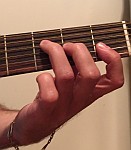
It is best to start this exercise with your fourth finger on the 12th fret.

Repeat the exercise on each fret and move it down to the first fret, or as far down the fretboard as you can.

Pick the strings in this order: 4-3-2-1-2-3-4 throughout.  Remember the strings are numbered from the thinnest 1, to the thickest 6.

In this exercise, you simply stretch one finger at a time.

Notice in the final diagram shown above that you have returned to the starting shape of this exercise.  Now you simply repeat the same pattern starting on the 11th fret.

Take it slowly and work on getting all of the notes clear.  For more powerful guitar technique building exercises check out my course How I Got Killer Guitar Chops While I Was Still in High School: Confessions of a High School Shredder.

  • Share/Bookmark