|
Order Now
"Who Else Wants to
Dramatically Improve Their Guitar Playing in Half the Time?"
"Introducing the Ultimate Accelerated Learning System for
Guitar...
Guitar Accelerator Gold"
From: Don J. MacLean
Thursday, 2:46 PM
The Guitar Accelerator Gold
gives you even more tools and powerful resources that will dramatically improve your
guitar playing.
You get everything
that's included in the Guitar Accelerator Silver Program and also get:
Mega Chops: Scale
Mastery Beyond Hanon
Soft Cover Book
World of Scales: A
Compendium of Scales for the Modern Guitar Player
Soft Cover Book
7 Secrets
to Master Any Guitar Chord Super-Fast
eBook
Guitar Music
Theory Unleashed Volume II
Soft Cover Book
|
How to
Improve Your Guitar Technique and Scale Mastery...
Mega Chops:
Scale Mastery Beyond Hanon
For more than a hundred years, the Hanon Studies
have been a staple in
technique development for the pianist. Now, these highly effective exercises
can be applied to the guitar to give you an excellent workout that will
improve your technique and mastery of the guitar.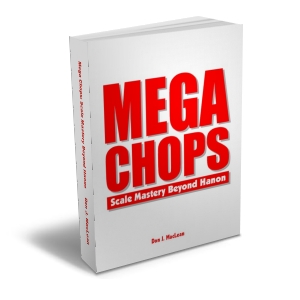
"But, Wait A Minute...There's a Huge
Difference Between Guitar and Piano, So Why Should I Spend Time Practicing
Old Piano Exercises?"
Yes there is a huge difference between the
guitar and the piano.
When you play these exercises on the guitar
you'll use different finger combinations than originally prescribed in the Hanon Studies.
But that's OK. In fact, you'll find that the Hanon Studies will give you an amazing guitar workout!
Here's the Really Good Part
These exercises will give you such a great
workout that you only need to practice 1-2 each week. That's
right. You only need to practice one or two Hanon Studies each week to
see measurable improvement in your playing. The rest of your practice
time can be spent on whatever you want.
The Magic Number is...
There are actually a total of 60 Hanon
Studies, but not all of them are equally effective for guitarists. So
what I've done is made
it real easy for you...
I've
narrowed the 60 Hanon Studies down to the 27 most effective for
guitar. These Top 27 Hanon Studies are shown in standard
notation and easy-to-read tab.
I've Made it Even Easier...
To make it much easier to learn the Hanon
Studies, the first section of this course shows you the most common scale
fingerings. Once you are familiar with the scale fingerings, all you
have to do is learn the order that the notes are used in each Hanon Study.
Add Spice to Your Solos
With your new scale knowledge, you can take
any of the Hanon Studies and easily play them in any key.
This is very
powerful. The Hanon Studies sound pretty cool on guitar! In fact
what you will probably end up doing is incorporating small sections of them
into your guitar solos. It will really add some variety to your
playing.
The Secrets to Improving Your Technique
In Mega Chops you will also find 44
proven technique exercises for massive chops. These exercises are a
great way to warm-up at the start of your practice session. You
certainly won't need to play all 44 exercises to warm-up. Depending on
your skill level you can use 1, 2, or more each week.
Mega Chops will also show you
everything you need to know about melodic patterns and sequences.
You'll learn how to play the most common melodic patterns and discover how
to create your own.
Mega Chops: Scale Mastery Beyond Hanon, will
show you virtually limitless ways to practice scales and improve your
technique.
Here is a small sample of what you'll get:
-
44 highly effective technique exercises for all
finger groups.
-
The
Top 27 Hanon Studies for the guitarist.
-
You'll
learn how to master the most common melodic patterns.
-
You'll
discover the secrets behind creating and applying melodic
patterns.
-
You
will also learn
how to play the Hanon Studies, or any melodic
pattern, over the entire fretboard in every key!
As you apply
the exercises found in Mega Chops, you'll love the
difference you hear in your playing!
Order Now |
|
"Imagine Your Guitar Solos
Burning Up and Down the Fretboard With Ease..."
"Introducing the Ultimate Guitar Scale Encyclopedia That Gives You
Total and Utter Scale Mastery…"
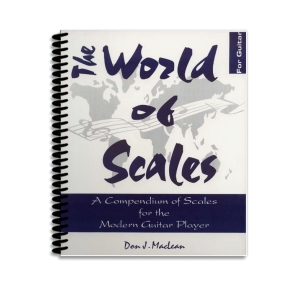
The World
of Scales: A Compendium of Scales for the Modern Guitar Player
You
probably already know that you should learn scales.
But have you ever
thought about why you should learn scales?
- Scales
are the foundation of music.
- Chords
are built from scales.
- Melodies
are built from scales.
- Guitar
solos are built from scales.
-
Once
you know scales, you’ll learn your favourite songs faster.
-
You’ll
learn songs easily by just watching other guitarists.
-
You'll
be able to easily learn
songs by ear.
-
As you master scales, you’ll improve your technique.
-
And of course
with your new scale knowledge, you'll create
killer guitar solos of your own.
Do You
Write
Your Own Songs? Or, Would You Like To?
As
an aspiring songwriter you absolutely must master scales.
 Without a good understanding of scales it’s like driving a car with
the emergency brakes on—you can move forward but only at a snail’s pace
and with way too much effort. Release the brake on your creativity by totally mastering
scales. Without a good understanding of scales it’s like driving a car with
the emergency brakes on—you can move forward but only at a snail’s pace
and with way too much effort. Release the brake on your creativity by totally mastering
scales.
What’s the
Best Way to Go About Learning Scales?
The
World of Scales: A Compendium of Scales for the Modern Guitar Player
is designed to teach you everything you need to know about scales.
This was my original teaching manual for scales.
So many of my students, their friends, teachers and pro guitarists
wanted their own copies, that I decided to get the book published.
- READING
MUSIC IS NOT REQUIRED.
Everything
is shown in tab and big easy-to-read fretboard diagrams.
- A
lot of scale books are hard to read visually, but that’s not a problem
with The World of Scales—there’s no straining to see
the notes. Each scale diagram is 1 3/4 X 1 3/8 inches.
|
An excellent resource for guitarists.
The World of Scales offers a wealth of interesting
sounds…much food for thought for the improvising guitarist.
John Stowell
Guitar Player Magazine
|
On
pages xviii-xxii you learn exactly how to get the most out of this ultimate
scale book.
Here
is a sample of what you’ll get in The World of Scales:
- Learn
how a simple secret will give you the freedom to use any scale to its
full potential. Page xviii
- You’ll
discover a simple
2-step process to play any scale in any key.
Pages xix-xxii
- Discover
some surprising secrets of scales.
Page 3
- Uncover
the most common scale groupings. Page
3
- Learn
the formula for the major scale. Page
4
- You’ll
learn how to identify any scale. Page 10
- Learn
the simple way to understand scale formulas.
Page 9
- Learn
the rule for notating and making sense of 7-note scales.
Page 9
- A
simple technique makes it easy to understand and remember any scale.
Page 10
- Discover
3 ways scales are named. Page 10
- You’ll
master the basics of intervals. Pages
5-9
- Discover
the powerful advantage you have over musicians from 10, 20 or 30 years
ago. Make sure you use this
overlooked advantage! Page
xvii
- As
you turn to page xvii you’ll find out what totally shocked
the famous composer Debussy in 1889.
|
The
World of Scales is an incredibly well
thought-out book that will open up the guitar for guitar players of
every level. Don MacLean has made a great contribution to the
advancement of this fine instrument and no doubt will continue to do so.
Michael
Gillette
Creator of
The Recreational Guitarist
|
The
World of Scales is Divided Into Two Parts for Quick and Easy Reference to
Specific Scales or Theoretical Concepts
Section
1
- In
Section 1 you’ll find everything you need to know to use EVERY scale.
Pages 3-50
Section
2
- Section
2 contains fingerings for each scale. Pages 51-139
- Each
scale form is shown on a separate page with as little text as possible.
This means you get an uncluttered view of all fingerings.
This is prefect for practicing!
- For
every scale you’ll find:
1.
The most common scale name and its many synonyms.
2.
Easy-to-use formulas to build scales from scratch.
3.
The scale fingerings.
- All
scale fingerings are moveable. This means you can take one fingering and move it up or
down the fretboard to easily produce any scale.
- The
black notes in each diagram represent the root notes.
All you have to do is look at the root notes to determine whether
you are playing a C scale or a B flat scale, etc.
The fingering that you are using will tell you whether it’s a C
major scale, C minor scale, B flat minor, etc.
This is a very easy system that will save you massive
amounts of time and eliminate frustration.
UNLOCK
THE FRETBOARD NOW
In
The World of Scales, no prior knowledge of music theory is required.
Here you will learn EVERYTHING you need to know about scales
from the ground up.
There
are so many cool scales in The World of Scales that you’ll want to
review the book every month.
These
scales will inspire your creativity.
What’s
in a Name?
There’s
a lot of confusion with scale names. Did
you know that Lydian b7, Mixolydian #4, Lydian Dominant,
Overtone and Mode
IV Jazz Minor, all refer to the same scale?
What a mess!
No
More Confusion
But
guess what? You won’t have
to worry about this or be confused by scale names anymore.
- You’ll
discover a very powerful way to learn scales.
Once you learn this technique, you’ll understand most if not
all of the synonyms for any scale.
- Most
importantly, you’ll understand the structure and many uses of all
scales! Pages 10-11
|
Awesome book!
This is "the scale book"!
It's the most complete scale book I have ever seen. This book really
does cover the world of scales. The author has obviously done tons of
research and makes the information easy to understand. There are some
pretty wild scales in this book that you really should spend some time
with. I found the Indonesian pentatonic scales to be really cool. And
what is really sweet about it, is that I can now see how to use these
scales in my own music.
The explanation of the modes is great.
I finally understand how the modes work! I have read a lot of other
scale books but this one gives the best explanation of the modes. I can
now apply modalization to any scale I want.
I found the book to be very
user-friendly. The layout is great. The scale fingerings are easy to
read. Another real cool thing about this book is its coverage of chord
theory. I now know how to determine the chords that will work with any
scale.
A reader on Amazon.com
|
Join
the Ranks of Elite Musicians
When
you master the contents of The World of Scales, you’ll be part of
the group of elite musicians that totally understand scales.
You’ll
be able to talk scales with any musician, even those with Ph D’s in music!
In fact I guarantee that you’ll know incredible stuff about scales
that most Ph D’s don’t even know.
But
talk is cheap. You’ll also be
able to put all of your knowledge to use on the fretboard.
After all that’s what playing the guitar is all about.
Isn’t it? You’ll be
able to talk the talk and let your fingers walk the walk.
The
Big One
I’m
now going to let you in on a big secret.
If you’ve been playing for a few months or more, you’ve probably
heard about those ridiculously complicated sounding things called the modes.
I call them “ridiculously complicated sounding things” simply
because…
Most
books and teachers make these scales RIDICULOUSLY more complicated than they
have to be.
The
Modes Demystified
The
modes are one of the most important areas that every guitarist must know.
Unless of course you don’t want to learn songs faster, and create
absolutely killer guitar solos and songs of your own.
This
absolutely crucial area is the most misunderstood area of music.
Most teachers make learning the modes way more complicated than it
needs to be.
At
Last! A Simple Solution to Understanding the Modes
In
The World of Scales you’ll discover the simple way to learn and
understand the modes. Pages 12-13
- You’ll
learn the inner workings of the modes.
Pages 12-13
- Totally
blow the lid off the psychological aspects of the modes.
Page 12
- Discover
melodic tendencies and the resolutions of notes. Page 12
- Master
the modes from the major scale.
Page 13
- Learn
how to modalize any scale. Page 12
- Uncover
the modes from harmonic and melodic/jazz minor. Pages 14-18
The
Boredom Buster, or 29 Great Ways to Practice Any Scale
In
chapter 2 you’ll learn the 4 most popular ways to practice scales.
Page 19
Next you get to the really juicy stuff about practicing scales:
- You’ll
totally transform how you practice scales once you start using digital
patterns. If you
don’t know what digital patterns are, you’ll be surprised at how
simple they are to apply and how vital they’ll become to your playing.
Page 20
- You’ll
learn 7 digital patterns and discover how to create your own.
Page 20
- Discover
a little-known secret that will show you how to create 100’s of very
cool melodic patterns. This
is something you won’t find in any other book!
- Every
musician I have shown this to is totally blown away.
These are very, very powerful ways to practice scales.
- You’ll
find 18 examples here and learn how to create 100’s
your own. Pages 21-25
What
About Chords?
The
World of Scales
is obviously an extensive book on scales.
But for you to totally understand how to use scales, you need to
understand chords.
- In
The World of Scales you’ll learn the 4-step formula to build any chord.
Page 27
- Flip
to page 29 and you’ll learn how to build triads. This means you will learn how to construct major,
minor, diminished, augmented, sus 2, sus
4 and flat 5 chords.
- On
pages 29-30 you’ll learn how to build any four-part chord.
You’ll learn the 18 different types of four part chords
(these are your 7th and 6th chords like major 7th,
dominant 7th, major 6th, etc.).
- You’ll
discover how to build all the 9th, 11th and 13th
chords. Pages 30-33
- Mystery
solved!
Since you’ll understand how chords are built, there will be no
more mystery to chord symbols.
- A
powerful yet simple approach to chord-scale relationships shows you how
to determine the chords that can be used with each scale.
Page 33
Little
Things Can Make All the Difference
Discover
some powerful little-known “little” scales.
These scales have limitless application and boy do they ever sound
cool!
- These
little scales are easy-to-apply and really add spice to your playing.
Pages 35-36
The
Power of Five: The World of Pentatonic Scales
When
you hear the word “pentatonic” you probably think of the very popular
five-note major and minor pentatonic scales.
These scales have very wide application, but you should also know
that there is a world beyond these pentatonic scales.
- You’ll
learn 16 different types of pentatonic scales.
Pages 37-40
- Also,
you’ll discover how you can create your own pentatonic scales.
This will lead to some very cool and original sounds!
Page 40
5+1
or 7-1=?
Six-note
(hexatonic) scales have a very unique sound.
I’m sure you already play at least one of these scales.
There are 6 other common hexatonic scales.
Do you know what they are? You’ll
find out on page 41. You’ll
also discover how to create your own hexatonic scales.
“But
wait a minute…with all of this technical sounding stuff, it sounds like
this could be a very complicated book”
You’re
right. This could be a
very dry, complicated and confusing book, but trust me, it’s not.
This book was first published in 1996.
It’s now in its 9th printing and I am continuously
getting letters and emails from satisfied readers. Guitar students love it,
guitar teachers love it, and the pros love it.
The
bottom line is, when I wrote this book I wanted it to be the most
comprehensive examination of scales available.
I also wanted it to be extremely user-friendly.
I
set the book up so you can work your way through it on your own.
You can work at your own pace—you won’t need a
teacher to walk you through this book.
Yes
there is a ton of information in this book.
When you get your hands on The World of Scales you’ll get:
- The
theory behind scales.
- 98
pentatonic (five-note) scale fingerings.
- 30
hexatonic (six-note) scale fingerings.
- 324
heptatonic (seven-note) scale fingerings.
- 60
miscellaneous scale fingerings.
- This
gives you a total of 512 scale fingerings.
- Since
you’ll learn how each fingering can be easily transposed to any of the
12 keys, The World of Scales gives you 6144 scales.
If you include the enharmonic equivalent keys you get a
total of 7680 scales!
- But
all this theory won’t do you any good if can’t see how to apply it
to the fretboard—this is why everything is applied to the
fretboard.
The
World of Scales
will give you information that you’ll be able to work on and return to for
many, many years.
You'll See
Immediate Results
The
great thing about this book is that you don’t have to work through the
entire book to see results. Just
read through the first chapter and I guarantee that scales will make total
sense to you.
Don’t
worry about information overload, on pages xviii-xxii you learn exactly how
to get the most out of this ultimate scale book.
“Ok,
So What Else is Covered in This Book?”
Chapter
7 examines the 7-note (heptatonic) scales that are among the most common
used in the West. You’ll
learn:
- Major
- Minor
- Harmonic
Minor
- Melodic
Minor/Jazz Minor
You
will also learn the related modes of each of these scales.
Pages 41-46
The
Erotic, Oops I Mean Exotic Scales, or Do I?
You’ll
learn the “exotic” scales from countries such as India,
Indonesia, Greece, Spain and much more!
Pages 46-48
Some
of these scales create some totally amazing sounds.
In fact some of these scales will “turn on” your creativity and
playing.
Figure Eight
In
chapter 8 you’ll learn the 8-note (octatonic) scales.
Here you’ll learn whole-half diminished, half-whole diminished,
Arabian, Ichikotsucho and the bebop scales.
Some very cool sounds here!
Just
In Case You Need to Know More About The World of Scales…
Here
are the scales you’ll find fingerings for in section two:
|
The
Scale Forms
Pentatonic
Scale Forms
Anhemitonic
Pentatonic Scales
Major Pentatonic Mode I (Chinese Pentatonic scale No. 1, Mongolian)
Sus
4 Pentatonic (Chinese Pentatonic scale No. 2, Egyptian, Mode ii Major
Pentatonic)
Major Pentatonic Mode iii (Chinese Pentatonic scale No. 3)
Major Pentatonic Mode IV (Chinese Pentatonic scale No. 4)
Minor Pentatonic (Chinese Pentatonic scale No. 5, Major Pentatonic
Mode V)
Hemitonic
Pentatonic Scales
Chinese Pentatonic scale No. 6 (Mode ii Miyako-bushi)
Miyako-bushi (Japanese Pentatonic scale No. 1, Kumoi-Joshi)
Hirajoshi (Japanese Pentatonic scale No. 2, Mode iii Miyako-bushi)
Japanese Pentatonic scale No. 3 (Mode IV Kumoi)
Iwato (Japanese Pentatonic scale No. 4 , Mode IV Miyako-bushi
)
In (Japanese Pentatonic scale No. 5)
Yo (Japanese Pentatonic scale No. 6)
Pélog (Indonesian Pentatonic scale No.1)
Indonesian Pentatonic scale No. 2
Indonesian Pentatonic scale No. 3
Kumoi (Hawaiian scale)
Hexatonic
Scale Forms
Augmented
scale mode I (sixtone Symmetrical)
Augmented
scale mode ii (sixtone Symmetrical)
Prometheus
Prometheus
Neapolitan
Whole-tone
Blues
Sus
4
Heptatonic
Scale Forms
Diatonic
Modes
Mode I
Ionian
Mode I
Ionian (Three Notes Per String Fingerings)
Mode ii
Dorian
Mode iii
Phrygian
Mode IV Lydian
Mode V Mixolydian
Mode vi Aeolian (Minor Scale)
Mode vi Aeolian (Three Notes Per String Fingerings)
Mode vii Locrian
Harmonic
Minor Modes
Mode I
Harmonic Minor
Mode I
Harmonic Minor (Three Notes Per String Fingerings)
Mode ii
Locrian Natural 6
(Tarz-nwin)
Mode
iii Ionian Augmented
Mode IV Dorian #4 (Nikris, Rumanian Minor)
Mode V
Mixolydian b9 b13 (Hejaz, Phrygian Major,
Spanish, Gypsy)
Mode vi
Lydian #9 (Musta-ar)
Mode vii Altered Dominant bb7
Jazz
Minor Modes
Mode I
Jazz Minor (Real Melodic Minor)
Mode I
Jazz Minor (Three Notes Per String Fingerings)
Mode ii
Dorian b2 (Javanese)
Mode iii Lydian Augmented
Mode IV Lydian b7 (Overtone scale, Mixolydian#4, Lydian
Dominant)
Mode V Mixolydian b13 (Mixolydian b6 Hindustan, Hindu)
Mode vi Locrian Natural 9 (Locrian #9, Locrian Natural 2, Locrian
Natural 9)
Mode vii Altered Dominant (Super Locrian)
Hejaz-Kar
(Byzantine, Double Harmonic, Gypsy)
Purvi
Todi
Saba
Hungarian
Major (Hungarian)
Hungarian
Gypsy No.1 (Hungarian Minor,
Mode IV Hejaz-Kar)
Hungarian
Gypsy No.2
Harmonic
Major (Suzinak)
Spanish
Dominant (Mode iii Harmonic Major)
Smyrneiko
(Mode IV Harmonic Major)
Mixolydian
b9 (Mode V Harmonic Major)
Enigmatic
Major
Locrian (Arabian)
Lydian
Minor (Mode vii Major Locrian)
Leading
Whole-tone (Mode V Major Locrian)
Persian
(Mode V Todi)
Oriental
No.1 (Mode ii Hungarian Gypsy No. 2)
Oriental
No.2 (Mode V Hejaz-Kar)
Neapolitan
Major (Mode IV Major Locrian)
Neapolitan
Minor (Harmonic Phrygian, Mode V Hungarian Gypsy No. 2)
Composite
Blues
Miscellaneous
Scale Forms
Octatonic
Scales Forms
Half-whole
Diminished
Whole-half
Diminished
Arabian
Japanese
(Ichikotsucho)
The
Bebop Scales
Major Bebop
Dorian Bebop
Mixolydian Bebop No.1
Mixolydian Bebop No.2
The
Chromatic Scale
|
Total
Scale Mastery
As
you can see, it’s all here! I
guarantee you’ll totally blow away your friends with your new mastery of
scales on two levels:
1.
Your knowledge and total understanding of the theory behind scales.
2.
Your application and understanding of scales on to the fretboard.
The
World of Scales
is 165 pages and 8.5 X 11. This
book is cerlox bound to stay open on your music stand or lie flat on a table
or chair. This means you can keep your hands where they’re supposed
to be—on the guitar.
Here’s
a quick recap of what you’ll get when you get your hands on The World
of Scales:
- You’ll
get everything you need to know to
totally understand scales.
- Understand
the mechanics behind scales and how to use them.
- You
get 98 pentatonic scale fingerings.
- 30
hexatonic scale fingerings.
- 324
heptatonic scale fingerings.
- 60
miscellaneous scale fingerings.
- This
gives you a total of 512 scale fingerings.
- Since
you’ll learn how each fingering can be easily transposed to any of the
12 keys, The World of Scales gives you 6144 scales. If
you include the enharmonic equivalent keys you get a total of 7680
scales!
- In
addition to these scales you’ll also get 29 tetratonic (four-note)
scales and 16 hybrid pentatonic scale ideas.
- Here
you’ll find answers to all of your questions.
- Everything
you need to know about scales is all in one place.
- Learn
at your own pace.
- Covers
every detail of scales.
- You
could spend $1000’s of dollars on guitar lessons trying to get this
crucial information!
- 100%
tested and proven.
- This
is the most thorough and complete scale book ever!
- It’s
your personal blueprint to scale mastery.
- Discover
tips, tricks and must-know information you won’t find anywhere else.
- Unleash
your creativity.
What
You Don’t Know Will Hurt You!
When
you don’t know scales, it’s like fumbling around in the dark rooms of a
mansion. With scale mastery,
you get to turn on the lights and see what you’ve been missing all this
time.
|
The Scale Bible
This is the best (and most used) reference
book I have. The large diagrams make learning scales very easy, and with
this many scales you need it to be easy. Everything from simple
pentatonic to the obscure is covered. Nice job!
Odin
Excellent book
and great service. Every guitarist should own this book.
Marty B.
Scales now make
total sense to me!
Nick F.
By far the best
scale book available. It's totally user friendly and easy
to use. A++++
Martin S. |
Isn’t
it time to learn songs faster, improve your technique, improvisation,
composition and totally master scales?
Grab Your
Copy Of Guitar Accelerator Gold Now
|
|
"At Last!
Secret Techniques the World's Best Guitarists Use to Learn Guitar
Chords...REVEALED!"
7 Secrets
to Master Any Guitar Chord Super-Fast
You
probably already know how important it is to learn guitar chords. In fact,
being able to play guitar chords is the single most important skill for all
guitar players.
Whether you want to become a totally
amazing guitarist or just be able to play your favourite songs, you'll find
that you must be able to play guitar chords.
But let's face it, learning chords can be a
time consuming task.
Think back to the last time you learned a
new chord. How did you go about achieving this? Did you follow a
proven system for learning chords? Chances are you probably took a
haphazard approach.
When you take a haphazard approach, you end
up wasting valuable practice time. After
all, it's a lot easier to forget how to play chords than it is to remember
how to play them.
There is a system that you can use to learn
chords and chord progressions effectively every time...
The
7 Secrets to Learn Any Guitar Chord Super-Fast
In
this course you'll discover the sure-fire formula to effectively learn chords every
time.
You'll learn
breakthrough techniques to effectively master any musical concept.
The 7 Secrets will also reveal the techniques that elite musicians
use when they practice.
In
the 7 Secrets to Learn any Guitar Chord Super-Fast you will:
-
Learn the most common guitar
chords and some of the not-so-common,
-
Learn
how to accompany any song,
-
Totally
understand the theory
behind chords,
-
Discover how to effectively learn
any chord.
The
Big 5
There are five main principles under which this
course was written:
Principle 1
Never Waste Valuable Practice Time
Here you will learn the most effective ways to
learn chords so you can maximize your learning.
There
are many good chord books that show you thousands and thousands of chord
voicings, but what they fail to show you is effective strategies to actually
learn these chords.
You can be shown one, one hundred or one thousand chord
voicings, but what’s the point if you are not shown how to actually learn
and remember the fingerings?
A
chord is only useful if you can play it from memory.
The 7 Secrets will provide you with highly effective physical and
mental techniques to learn any chord.
When
you apply the 7 Secrets to every chord, you will learn and master chords faster, be
able to apply them and retain them indefinitely.
Principle 2
You Don't Really Need to Know Every Single
Chord
There
are thousands and thousands of different guitar chords and voicings, but in
most situations you will find that only a relatively small number are
actually used. This means that
once you learn the most common chords you will be able to play hundreds of
thousands of songs.
The 7
Secrets to Learn any Guitar Chord Super-Fast will show you the most
frequently used chords. Once
you have learned these chords and the techniques contained in this book, you
will have the tools to easily and effectively learn any additional advanced
voicings you desire.
Principle 3
Learn Chords in Order of Priority
Learn
the most common chords before you move on to the complex and beyond to the
obscure.
Section 3 of this book
shows you the most common basic chords.
These chords are easy to play and are the first chords that every
guitarist should learn.
Section 5 shows you the most common moveable chords and shows
you the exact order in which you should learn these chords.
Principle 4
When You Understand Something, You'll Learn
Faster
When
you learn the basic theory behind chords you make it much easier to learn
chords. Imagine trying to
memorize a sentence in a language that you cannot speak or read. If
you were shown the translation word for word, you would find it much easier
to memorize.
Once you
understand the basic theory behind chords, you will discover that chords can
be very easy to understand and memorize.
Learning theory doesn’t have to be hard or boring.
Section 7 provides you with a simple way to understand chord theory
and shows you how you can apply it to the neck of the guitar.
Principle 5
Application, application, application!
Finally,
you can have a chord perfectly memorized and understand the theory behind
the chord, but to truly master a chord you must know how it can be applied.
To do this you should look for songs that use the new chord. Once you have found one or more songs that use the chord,
learn to play the song. You
can either learn the song note-for-note or you can just strum along.
Section 6 of this book will show you how to accompany any
song.
The
other way you should apply a new chord is to create your own chord
progressions that use the chord. It
doesn’t have to be anything too elaborate.
Just experiment a bit with the chord and let your ears be the judge.
Where does the chord sound like it wants to move to next?
As your knowledge of theory increases, you will be able see and hear
many additional uses for any chord.
| Ground-Breaking
Book!!! The 7 Secrets is the BIBLE for
learning guitar chords. It covers every aspect of playing and
learning guitar chords. And what's really great, is that it
makes it really easy to understand, and apply the
techniques.
I'm very happy with how quick I can
now learn new chords. I wish I would have had this book when I
first started to play!
Mike K.
The Indispensable
Chord Book
The 7 Secrets is an
amazing resource for learning guitar chords. No guitarist should
be without it. The book has tons of tips, and tricks, and really
practical info on chords. The book is easy to read understand
and use.
Rob G.
Powerful System for
Learning Chords
This is it. Look
no further. If you want a great eye-opening way to learn guitar
chords, the 7 Secrets is it.
M.K.
|
As
you can tell by now, the 7 Secrets to Learn any Guitar Chord Super-Fast
is not your ordinary chord book.
This is a “how-to-learn-more-chords-in-less-time” book.
The
7 Secrets to Learn any Guitar Chord Super-Fast
is designed for guitarists of all levels.
Here is brief look at what you will learn in this course:
-
You will discover exactly how to learn
chords.
You will master the most effective techniques to learn chords.
No more guesswork involved.
-
Increase your understanding of chords.
-
Discover how you can use advanced learning strategies to learn
any
musical concept.
-
How to effectively develop finger
memory.
-
How to determine the optimum way to switch from one chord to next
regardless of the chord progression. In
other words, this course will show you how to transition from one chord to the
next in the smoothest possible way, with the absolute minimum finger
movement.
-
You
learn the secrets of how to minimize wasted finger movement.
-
You will learn how to isolate trouble spots
in a chord, or chord progression, and determine the most
effective way to correct them.
-
Learn
how to accompany any song.
-
This
course will show you the most common chords from open string to barre
chords.
-
You will
learn basic major and minor chords all the way up to 13th
chords.
-
You will learn the basic theory behind chords and most importantly, you
will see how to apply this theory to the neck of the guitar.
-
You will totally understand how chords are symbolized.
-
You will understand chord inversions and slash chords and be able to
apply them to the neck of the guitar.
Use
This Book to Get More Out of ANY Chord Book You Already Own
The
7 Secrets to Learn any Guitar Chord Super-Fast can be used as a stand-alone
chord book, or can be used to get more mileage out of any chord book
you already own.
You may be curious to know exactly how many chord
voicings you will find in this book. You get:
-
36 basic open string
chords
-
136 moveable barre chords that can be transposed to any of the 12 keys
giving you 1632 chords
-
48 voicings for inversions
-
In total you get 1680 chord voicings!
In
This Book You Will Learn Which Chord You Should Learn 1st, 2nd, 3rd, 4th,
etc
Remember,
there is no need to be overwhelmed by the 1680 chord
voicings. In this course you will
discover the exact order to learn these chords based on the style of music
you currently play or aspire to play.
In
other words, you will discover how to learn the chords that you need to
learn so you can play you favourite songs.
This will be a surprisingly small number. Once you have mastered these chords you can go on to learn additional
chords that will add variety to the music you play.
Grab Your
Copy Of Guitar Accelerator Gold Now
|
|
How to
Totally Understand Intermediate Level Guitar Theory and Apply it Where it
Matters Most...
The Neck of
Your Guitar
Guitar
Music Theory Unleashed Volume II
This Guitar Music
Theory Unleashed Volume II picks up right where the Absolute Essentials of Music Theory
for Guitar leaves off. Absolute Essentials of Music Theory
for Guitar leaves off.
Let's Take Quick
Peek at What You'll Learn...
In this course you'll
learn all about four-part chords.
-
You'll learn what the
17 different types of four-part chords are, how to play them in all
inversions and of course you'll learn how to use them.
-
You'll learn four-part chord-scales (this means you'll learn how to build 7th chords off
of each note of the major, minor, harmonic minor and melodic/jazz minor
scales).
In
Guitar Music Theory Unleashed Volume II
you'll learn all about chord progressions.
-
You'll learn the most
popular chord progressions and see how you can identify them on paper and by
ear.
This means you'll be able to recognize and understand the chord progressions
used in your favourite songs, or just about any song for that matter!
-
You'll also learn how
to create your own chord progressions.
-
When you understand chord progressions you'll
give yourself a powerful accelerated learning tool. Instead of learning
songs by rote, you'll now have an easy-to-use numbering system for learning the
chords of songs in any key. And by the way, the numbering system for
understanding chord progressions is really, really simple—if
you can count to seven you can use it!
The
Modes Demystified
If you’ve been playing for a few months or more, you’ve probably
heard about those ridiculously complicated sounding things called the modes.
I call them “ridiculously complicated sounding things” simply
because…
Most
books and teachers make these scales RIDICULOUSLY more complicated than they
have to be. Now don't get me wrong—they are not intentionally doing this—it's
just because they've never been shown a better way.
The
modes are one of the most important areas that every guitarist must know—unless of course you don’t want to learn songs faster, and create
absolutely killer guitar solos and songs of your own.
At
Last! A Simple, and Practical Solution to Understanding the Modes
In
Guitar Music Theory Unleashed Volume II you’ll discover the
easy way to learn and
understand the modes.
-
You'll learn what Ionian,
Dorian, Phrygian, Lydian, Mixolydian,
Aeolian and Locrian scales really are and how you can use them.
-
You'll learn fingerings
for each of the modes and most importantly, you'll learn how to use the
diatonic and relative modes.
-
In
Guitar Music Theory Unleashed Volume II
you'll learn about modal songs and you'll get powerful modal memory tips.
-
You'll also learn all
about chord-scale relationships. This means you'll understand what
chords goes with what scales, or what scales work with what chords.
This will make improvising and creating your own guitar solos
easy.
And this is just some of what
you'll master in Guitar Music Theory Unleashed Volume II.
So what are you waiting
for?
Isn't it time to dramatically improve your guitar playing and
understanding of music?
Grab Your
Copy Of Guitar Accelerator Gold Now
|
|
READING
MUSIC IS NOT REQUIRED!
All musical examples are shown in tab,
standard notation, and easy-to-read neck diagrams.
|
Simply
click here to improve your guitar playing today, 100%
Satisfaction Guaranteed!
|
Guitar Accelerator
Gold Program
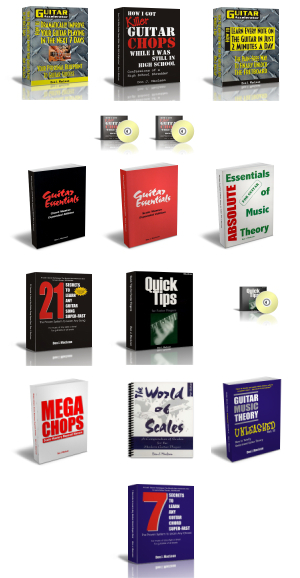
How to Dramatically
Improve Your Guitar Playing in the Next 7 Days: Your Personal
Blueprint to Guitar Success
eBook ($47
Value)
How I Got Killer Guitar
Chops While I Was Still in High School: Confessions of A High School
Shredder
eBook with audio MP3s
($47 Value)
Quick Tips for
Faster Fingers
eBook with audio MP3s
($25.99 Value)
Guitar Essentials:
Chord Master
Expanded Edition
Soft Cover Book
($17.99 Value)
Guitar Essentials:
Scale Master Expanded Edition
Soft Cover Book
($19.99 Value)
How to Learn Every Note on The
Guitar in Just 2 Minutes a Day: The Pain-Free Way to Finally Unlock the
Fretboard
eBook
($19.99 Value)
21 Secrets to
Learn Any Guitar Song
Super-Fast
eBook
($47.00 Value)
Absolute Essentials of
Music Theory for Guitar
Soft Cover Book with
Answer
Key ($22.99 Value)
Mega Chops: Scale
Mastery Beyond Hanon
Soft Cover Book
($25.99
Value)
The World of
Scales: A Compendium of Scales for the Modern Guitar Player
Soft Cover
Book
($19.95 Value)
7 Secrets
to Master Any Guitar Chord Super-Fast
eBook
($25.99 Value)
Guitar Music
Theory Unleashed Volume II
Soft Cover Book
($35.99 Value)
Total Retail Value = $355.87
|
|
If you want to make dramatic improvements
in your guitar playing and understanding of music,
then
Grab Your
Copy Of Guitar Accelerator Gold Now.
My Iron-Clad Total
Satisfaction Guarantee to You
 |
If you're not 100% thrilled with the
Guitar Accelerator Gold, or
if you decide for whatever reason, that this program is not right for
you, simply return the Guitar Accelerator Gold within 90 days for a
prompt and courteous full refund and you still get to keep the bonuses
for just giving it a try! |
|
"For A Limited Short Time, You
Qualify To Receive These 12 Valuable Bonus Gifts...FREE"
($200.74 Value)
When
you get
your copy of the
Guitar Accelerator today, you'll also
get 12 FREE
digital bonuses.
Super Bonus
#1 Guitar Accelera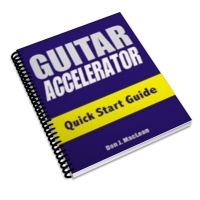 tor
Gold
Quick Start Guide tor
Gold
Quick Start Guide
In the Guitar Accelerator Gold Quick Start Guide you get a
step-by-step guide that shows you how to apply this program for maximum
results.
A $9.99 Value,
Yours FREE!
Super
Bonus #2
How I Got Killer Guitar Chops While I Was Still in High School:
Confessions of a High School Shredder Practice Journal
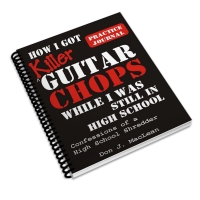
In this companion practice journal
you'll learn how to create your
own custom Super-Chops Workouts and track your success.
All you
have to do is fill in the blanks and grab your guitar.
A $14.99 Value,
Yours FREE!
Super
Bonus #3
Shred Fest: How to Master Lightning Fast Single-String Scales
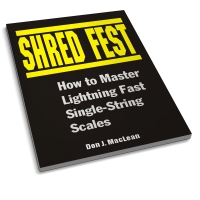 You've
heard them before You've
heard them before —those
lightning fast single-string licks your favorite shred guitarists use.
Now
it's your turn!
In Shred Fest: How to Master Lightning Fast
Single-String Scales you'll discover exactly how to practice and master
single string passages so you will be rifling them off like a master guitar
shredder in no time.
A $17.99 Value,
Yours FREE!
Super
Bonus #4
21
Knock Your Socks Off Killer Shred Guitar Pieces
 The title says it all. The title says it all.
In 21 Knock
Your Socks Off Killer Shred Guitar Pieces in Tab you'll get 21 amazing
pieces you can use to show off your new killer shred guitar chops!
A $17.99 Value,
Yours FREE!
Super
Bonus
#5
15
Mega Memory Secrets Every Guitarist Must Know
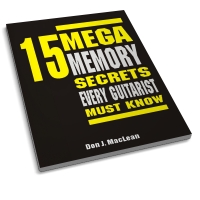
Save hours of practice time when you master these 15 extremely powerful techniques.
Use these secrets to memorize
anything on the guitar!
A $19.97 Value,
Yours FREE!
Super
Bonus
#6
The "Invisible Box" Method of
Understanding Chord Symbols
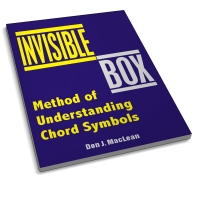 The "Invisible Box" Method of
Understanding Chord Symbols gives you the 14 must know keys to read and understand chord symbols. The "Invisible Box" Method of
Understanding Chord Symbols gives you the 14 must know keys to read and understand chord symbols.
A $14.97 Value,
Yours FREE!
Super
Bonus #7
What Key Am I In?

Mystery Solved!
How
to quickly and easily know what key your favourite song is in.
When you understand keys, you will learn songs much faster—this special
report shows you how to do it with or without sheet music.
A $14.97 Value,
Yours FREE!
Super
Bonus
#8 Unleashing the Power of Learning Maps

In
Unleashing the Power of Learning Maps you'll learn how to create
powerful Learning Maps for the Absolute Essentials of Music Theory for
Guitar. Use this potent visual technique to:
-
learn faster
-
increase understanding
-
see the “big picture”
Once
you realize how easy it is to use Learning Maps, you’ll want to apply them
to learn just about everything!
A $19.97 Value,
Yours FREE!
Super
Bonus
#9
Making Sense of Guitar Scale Box
Patterns In Spite of What You May Have Been Taught
 Has
this ever happened to you? Has
this ever happened to you?
You're jamming with a friend and he or she plays a scale that you know
fairly well. The strange thing is you notice that your friend uses a
completely different fingering than you were taught.
Or,
you look up a scale in a few scale books and see that each book
shows totally different scale fingerings for the same scale.
What
gives? Who's right?
In
Making Sense of Guitar Scale Box Patterns In Spite of What You May Have
Been Taught you'll get the answers to these questions and more, and
learn how you can use scale box patterns to fly all over the fretboard.
A $19.99 Value,
Yours FREE!
Super
Bonus #10
47 Killer Arpeggios Every
Guitarist Must Know
 47 Killer Arpeggios Every
Guitarist Must Know will give you 47 super-cool arpeggios. Some are easy
to play, while others are monsters.
The bottom line is they all sound great! 47 Killer Arpeggios Every
Guitarist Must Know will give you 47 super-cool arpeggios. Some are easy
to play, while others are monsters.
The bottom line is they all sound great!
A $14.97 Value,
Yours FREE!
Super
Bonus
#11 Finger-Style Master
Class: How to Finger-Pick Chords
 In Finger-Style Master
Class: How to Finger Pick Chords you learn exactly how to apply
finger-picking to chords. You get 48 finger-style exercises that will build your finger-picking chops. Also included are 3 cool
finger-picking songs. In Finger-Style Master
Class: How to Finger Pick Chords you learn exactly how to apply
finger-picking to chords. You get 48 finger-style exercises that will build your finger-picking chops. Also included are 3 cool
finger-picking songs.
After you work through this master class you'll
never be stuck trying to come up with a finger-picking pattern for a
chord progression! Examples are shown in tab, standard notation and
fretboard diagrams.
A $19.97 Value,
Yours FREE!
Super
Bonus
#12 Fretboard Fury: 7 Powerful Technique-Building
Songs
 The title says it all: Fretboard Fury: 7 Powerful Technique-Building
Songs. In this special report you learn 7 pieces that will
challenge you and improve your guitar technique. The title says it all: Fretboard Fury: 7 Powerful Technique-Building
Songs. In this special report you learn 7 pieces that will
challenge you and improve your guitar technique.
These pieces sound
great at any tempo and will allow you to perfect your vibrato, alternate
picking, hammer-ons and pull-offs, and sweep picking.
A $14.97 Value,
Yours FREE!
Total Bonus Value = $200.74
|
|
In all, this special offer brings you a total of
$556.61 worth of products and discounts that will dramatically improve your
guitar playing for only $197.
That's right! For
less than what you would pay for 3.5 hours of private instruction, you'll get
this fully-loaded, jam-packed accelerated learning course that you'll use to make
massive improvements in your playing.
So who will you impress
first with your new guitar playing skills?
WHAT ARE YOU WAITING FOR? To start
improving your playing risk-free in the next 5 minutes, simply
click here
to claim your copy of Guitar Accelerator Gold now.
To your guitar success,

Don J. MacLean
Don J. MacLean is one
of the world's leading authorities on accelerated learning systems for
guitar—with
students using his methods in more than 40 countries worldwide. Don is the author of over 30 books
including How I Got Killer Guitar Chops While I Was Still in High
School: Confessions of a High School Shredder, 21 Secrets to Learn any Guitar Song
Super-Fast, 7 Secrets to Learn any Guitar Chord Super-Fast, Guitar Essentials: Chord Master Expanded
Edition, The World of Scales, and the Absolute Essentials of
Music Theory for Guitar.
P.S.
The Guitar Accelerator Gold gives you the ultimate gift—the gift of time.
You'll know how to do more with less time. Regardless of how much time
you have to practice, you'll know how to get everything out of those
precious minutes and have lots of fun. What would have taken you
several months to do, you'll now be doing in a matter of weeks. The
sooner you get started, the faster you'll start experiencing great results.
So why not get started in the next 5 minutes?
P.P.S.
Act
now
to
ensure that you get your
12 FREE Super Bonuses valued at $200.74. Grab your Guitar Accelerator Gold Package now!
© Copyright 2008, 2005 Don
J. MacLean
|